
Tsavo East and Tsavo West National Parks: Discover Kenya’s Largest and Most Untamed Safari Wilderness
When travelers dream of Africa, they often imagine endless landscapes, vast herds of wildlife, dramatic sunsets, and adventures in truly wild places. Few destinations embody that vision more completely than Tsavo East and Tsavo West National Parks.
Together forming one of the largest protected wildlife ecosystems in the world, the Tsavo Conservation Area covers more than 22,000 square kilometers of spectacular wilderness in southeastern Kenya. This immense landscape is larger than some countries and offers visitors a safari experience unlike anywhere else in Africa.
While Kenya is famous for destinations such as Maasai Mara and Amboseli, Tsavo remains one of the country’s best-kept safari secrets. It offers a sense of scale, solitude, and authenticity that is increasingly rare in modern tourism. For international visitors seeking adventure, exceptional wildlife encounters, dramatic scenery, and a genuine connection with nature, Tsavo East and Tsavo West deliver one of Africa’s most rewarding safari experiences.
Where Are Tsavo East and Tsavo West National Parks?
Tsavo East and Tsavo West National Parks are located in southeastern Kenya, stretching between Nairobi and Mombasa. The two parks are separated by the main Nairobi–Mombasa highway and railway line, yet together form one giant, unbroken wilderness ecosystem.
Their strategic location makes Tsavo the absolute perfect safari extension for visitors wishing to combine a rugged Kenyan safari with a tropical beach holiday on the Indian Ocean coast.
Travel Distance & Times
From Nairobi: Approximately 230–300 kilometers depending on your designated park entrance gate. (Travel time by road: 4–6 hours).
From Mombasa: Approximately 100–250 kilometers depending on the gate. (Travel time by road: 2–4 hours).
Easy Access for International Visitors
One of Tsavo’s greatest advantages is how seamlessly it can be woven into a broader Kenyan holiday using various modes of transport:
By Road: Well-maintained highways connect the parks to both Nairobi and Mombasa. Visitors can easily include Tsavo within a multi-destination itinerary covering Amboseli, Maasai Mara, Lake Nakuru, or beach hotspots like Diani Beach, Watamu, and Malindi.
By Air: Several strategically placed airstrips within both parks serve scheduled and private charter safari flights daily.
By Rail: Kenya’s modern Standard Gauge Railway (SGR) provides a truly unique safari travel option. With passenger stations located near the boundaries of Tsavo, visitors can combine a scenic, comfortable rail journey through the countryside with their wild game drives.
Tsavo East National Park: The Land of Red Elephants
The Largest National Park in Kenya: Tsavo East is one of Kenya’s oldest and largest national parks, covering approximately 13,700 square kilometers. Its immense open landscapes create a classic, cinematic safari setting characterized by flat, endless plains, lonely acacia silhouettes, and impossibly distant horizons. Because the terrain is wide open, wildlife is often significantly easier to spot across the vast scrubland.
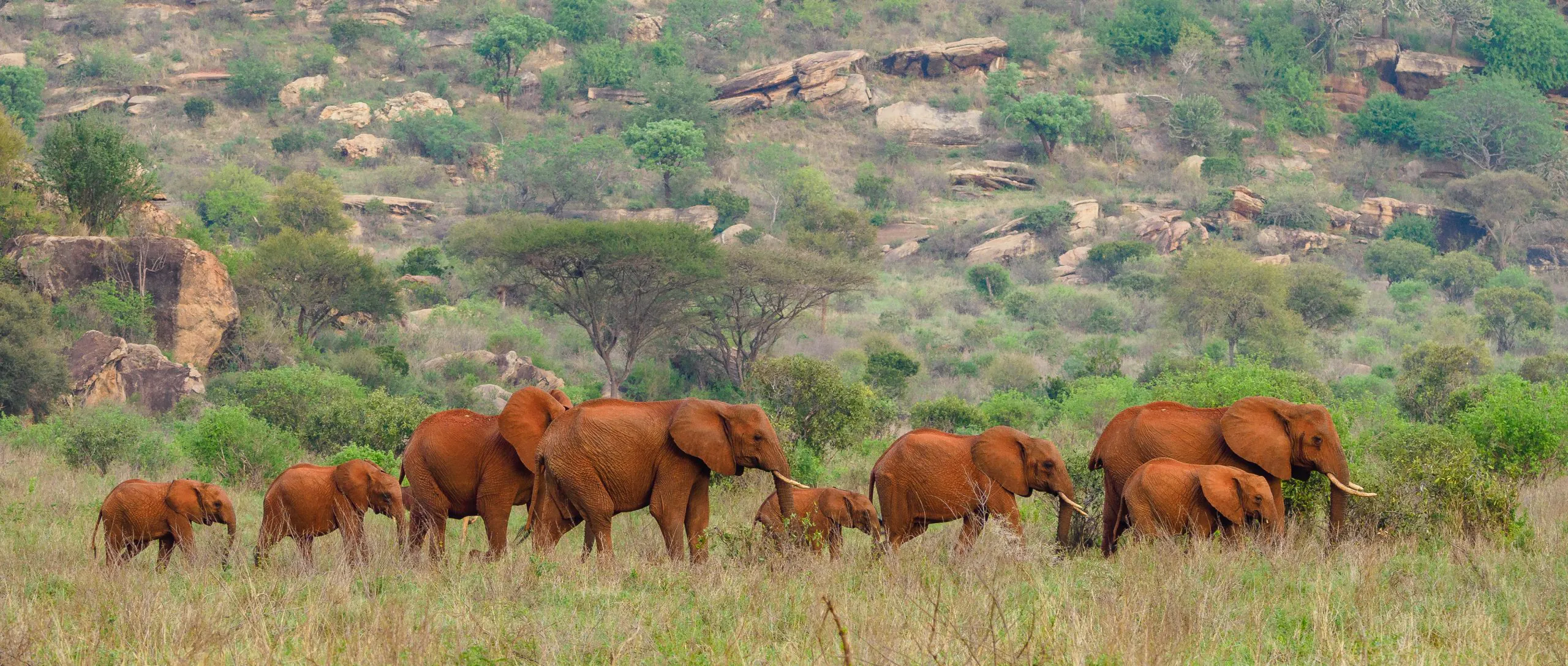
The Famous Red Elephants: Perhaps the most iconic symbol of Tsavo East is its population of “red elephants.” After bathing in the rivers or dusting themselves in the park’s distinctive red volcanic earth, these majestic animals acquire a striking, rich reddish coat. Seeing these dust-covered giants—especially massive, long-lived “big tuskers”—marching past giant baobab trees at sunset is a photographer’s dream.
The Legendary Man-Eaters of Tsavo: Tsavo occupies a thrilling place in history due to the famous “Man-Eaters of Tsavo.” In 1898, two massive, mane-less lions terrorized and halted the construction of the Uganda Railway by attacking camp workers. This gripping piece of African history inspired the famous Hollywood film The Ghost and the Darkness. Today, visitors are fascinated to track the descendants of these bold lions, which still rule the Tsavo plains.

Top Geological Wonders of Tsavo East
The Yatta Plateau: Stretching over 290 kilometers, this dramatic ridge is recognized as one of the world’s longest ancient lava flows. It frames the park’s northern horizon and creates a spectacular, ancient backdrop.
Lugard Falls: Located along the Galana River, this site consists of a series of roaring rapids and narrow white-water rock formations sculpted into smooth, bizarre shapes by rushing waters over thousands of years.
Galana River: The lifeblood of Tsavo East, this palm-fringed river provides a crucial year-round water source, attracting massive concentrations of hippos, Nile crocodiles, and thirsty elephant herds.
Tsavo West National Park: While Tsavo East is defined by flat, open plains, Tsavo West presents a dramatically different visual world. Covering approximately 9,000 square kilometers, it is a highly dynamic environment of emerald-green hills, ancient volcanic cones, black rock fields, and hidden freshwater springs. It is widely regarded as one of Kenya’s most beautiful and visually striking national parks.
Mzima Springs: The crown jewel of Tsavo West is Mzima Springs. Fed by an immense underground river filtering down from the volcanic rocks of the nearby Chyulu Hills and Mount Kilimanjaro, the springs pump out millions of liters of crystal-clear water every single day.
This lush, palm-fringed oasis is a sanctuary for massive rafts of hippos, crocodiles, vervet monkeys, and thirsty big game. A unique feature here is an underwater glass viewing chamber, allowing visitors to walk beneath the surface and view hippos and fish gliding through the clear water from a fish-eye perspective.
The Shetani Lava Flow: Tsavo West’s rugged terrain was violently shaped by relatively recent volcanic activity. The most spectacular evidence of this is the Shetani Lava Flow. Meaning “devil” in Swahili, Shetani is a vast, jagged black lava field that stretches for miles across the savannah like a frozen, petrified river of black stone. Visitors can get out of their vehicles to explore the eerie caves and walk across the crisp, dramatic volcanic terrain.
Exceptional Rhino Conservation at Ngulia
Tsavo West plays a critical role in saving one of Africa’s most endangered species through the Ngulia Rhino Sanctuary. This heavily fortified, secure zone protects a thriving population of critically endangered black rhinos. It provides one of the absolute best opportunities in East Africa for lucky travelers to spot these highly elusive, prehistoric giants in the wild.
Comprehensive Tsavo Ecosystem Matrix
| Feature | Tsavo East National Park | Tsavo West National Park |
| Size | ~13,700 square kilometers (Larger) | ~9,000 square kilometers |
| Primary Terrain | Flat, semi-arid plains, open savannah, red volcanic soil. | Volcanic cones, green hills, rocky ridges, black lava flows. |
| Key Water Source | Galana River (Lugard Falls) | Mzima Springs (Underground meltwater) |
| Iconic Wildlife Sight | “Red Elephants”, large tuskers, prides of lions. | Black Rhinos (Ngulia Sanctuary), Hippos, Leopards. |
| Geological Highlights | Yatta Plateau (World’s longest lava flow). | Shetani Lava Flow, Roaring Rocks, Chaimu Crater. |
| Vibe | Vast, lonely, open, endless horizons. | Scenic, dramatic, enclosed, mountainous. |
Premium Accommodations in the Tsavo Wilderness
Tsavo offers world-class safari accommodation options ranging from ultra-exclusive luxury eco-resorts to historical tented camps that evoke the classic, old-world glamour of early African exploration.
Top Luxury Lodges & Camps to Book
Finch Hattons Luxury Tented Camp (Tsavo West): The absolute gold standard of luxury in the park. This award-winning camp features opulent tents with freestanding copper bathtubs, elevated yoga decks, a luxury spa, and private decks overlooking spring-fed hippo pools.
Kilaguni Serena Safari Lodge (Tsavo West): Superbly built out of local volcanic stone, this historic lodge sits directly in front of a highly active waterhole. Guests can view hundreds of elephants and buffalo arriving to drink directly from the open-air dining terrace, all framed by Mount Kilimanjaro.
Satao Camp (Tsavo East): Nestled under a grove of ancient tamarind trees, this intimate tented camp faces a major watering hole, bringing Tsavo’s famous red elephants directly to your private veranda.
Galdessa Camp (Tsavo East): Hidden away on the rocky banks of the Galana River under a canopy of doum palms, this eco-luxury camp offers unparalleled privacy and striking views of the Yatta Plateau.
Best Time to Plan Your Tsavo Safari
June to October (Peak Dry Season): The premier window for wildlife viewing. Water holes dry up across the hinterlands, forcing thousands of animals to gather along the permanent channels of the Galana River and Mzima Springs. Vegetation is thin, making game tracking incredibly easy.
January to March (Warm & Clear): Beautiful, hot, and highly clear skies that offer exceptional clarity for viewing distant landscapes and photographing the red soil against a deep blue sky.
November, April & May (The Green Season): The rains bring a dramatic transformation. The red dust settles, replaced by a carpet of lush emerald green. It is a peaceful time with lower lodge rates, zero vehicle crowds, and a paradise for birdwatchers tracking over 500 species of resident and migratory birds.
Conclusion
Tsavo East and Tsavo West National Parks represent Africa at its most wild, diverse, and awe-inspiring. From the legendary red elephants and historical lion prides of Tsavo East to the crystal-clear desert oases and volcanic fields of Tsavo West, this massive ecosystem offers a pure safari experience unmatched in scale. For travelers wishing to step off the heavily crowded tourist trails and feel the true, untamed heartbeat of old Africa, the wild frontier of Tsavo awaits.